Komodo vs Raja Ampat: Best Luxury Phinisi Sailing Destinations
- Topography: Komodo features sun-scorched savanna hills and volcanic ridges, while Raja Ampat is a labyrinth of over 1,500 jungle-clad limestone karst islands.
- Marine Life: Komodo is famed for manta rays and strong currents, whereas Raja Ampat holds the record for fish species sighted on a single dive (374).
- Accessibility: Komodo is a one-hour flight from Bali; Raja Ampat requires a multi-leg journey to Sorong, reflecting its profound remoteness.
The gentle groan of ironwood timbers underfoot, the faint scent of clove on the sea breeze, the vast, turquoise expanse unfurling towards the horizon—this is the sensory preamble to a decision every discerning mariner in Indonesia must face. It is a choice between two titans of the archipelago, two realms that define the pinnacle of exploration by sea. From the deck of a hand-crafted phinisi, the question hangs in the humid air: do we set our compass for the primal, dragon-guarded savannas of Komodo, or for the kaleidoscopic, life-saturated waters of Raja Ampat? This is more than a choice of itinerary; it is a choice of narrative, a fundamental fork in the path of a great Indonesian odyssey.
The Primordial Realm: Sailing Komodo’s Dragon-Guarded Isles
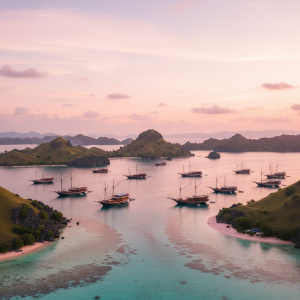
To sail into Komodo National Park is to journey back in time. The landscape is stark, powerful, and almost shockingly arid. Unlike the lush, volcanic cones that dominate much of Indonesia, Komodo’s 29 islands are defined by sun-scorched hills that bake to a deep ochre in the dry season, fringed by startlingly white—and occasionally pink—sands. “You feel the age of the earth here,” explains Captain Adnan Saputra, a 30-year veteran of these waters. “The currents are strong, the sun is intense, and the animals are not just animals; they are relics.” He is, of course, referring to the archipelago’s most famous resident: the Komodo dragon. Seeing these three-meter-long predators, of which some 5,700 remain, patrolling the shores of Rinca or Komodo Island is a visceral, humbling experience that anchors the entire journey in a deep, evolutionary context. This is, after all, a UNESCO World Heritage Site for a reason. But the primeval allure extends beneath the waves. The diving here is not for the faint of heart; it’s a theater of action. Sites like Batu Bolong and Castle Rock are washed by powerful currents, which in turn attract immense schools of fish, giant trevally, and reef sharks. The main draw for many, however, is the reliable congregation of majestic reef mantas at Manta Point, where these gentle giants, with wingspans reaching up to five meters, glide effortlessly through the plankton-rich cleaning stations. This is the classic indonesia luxury phinisi experience: a blend of iconic wildlife, dramatic landscapes, and exhilarating marine encounters, all within a compact and navigable area.
Raja Ampat: The Epicenter of Marine Biodiversity
If Komodo is a drama, Raja Ampat is an epic of staggering scale and complexity. Located off the northwest tip of New Guinea, the “Four Kings” archipelago is the undisputed heart of the Coral Triangle and, by any scientific measure, the most biodiverse marine environment on Earth. The numbers are simply dizzying: over 1,700 species of reef fish, 600 species of hard coral (representing 75% of the world’s known species), and a landscape of more than 1,500 jungle-draped karst islands scattered across 40,000 square kilometers of sea. It was here, at the dive site Cape Kri, that marine biologist Dr. Gerald R. Allen set a world record by identifying 374 distinct fish species on a single 90-minute dive. “It’s not about finding life,” a divemaster once told me as we prepared to descend into the blue, “it’s about processing the sheer volume of it.” Below the surface, the reefs are not merely reefs; they are cities of coral, pulsating with a density of life that recalibrates one’s understanding of a healthy ecosystem. Wobbegong sharks camouflage on the seafloor, pygmy seahorses cling to gorgonian fans, and vast schools of fusiliers create shimmering rivers of blue and gold. The topside experience is equally compelling. Kayaking through the serene, cathedral-like passages of the Fam Islands or trekking at dawn to witness the elaborate mating dance of the Wilson’s Bird of Paradise offers a profound connection to a world that feels untouched by time. A voyage here is less a tour and more an expedition into the planet’s last great marine wilderness.
Accessibility and Seasonality: The Logistics of a Grand Voyage
The practical considerations of reaching these two paradises are as divergent as their ecosystems, a critical factor in answering the best luxury phinisi komodo vs raja ampat question. Komodo stands as the more accessible of the two. The gateway is Labuan Bajo (LBJ) on the island of Flores, a bustling port town serviced by multiple daily 60-minute flights from Bali’s Ngurah Rai International Airport (DPS). This ease of access makes Komodo an excellent choice for itineraries of 5 to 8 nights, easily combined with a land-based stay in Bali. The prime sailing season is long and aligns with the Northern Hemisphere’s summer, running from April through November, with the absolute best conditions—calm seas and clear skies—found between June and September. Water temperatures can be surprisingly cool, occasionally dipping to 24°C in the southern part of the park. Raja Ampat, conversely, demands a greater commitment to travel. The entry point is Sorong (SOQ) in West Papua, typically reached via connecting flights from Jakarta (CGK) or Makassar (UPG). The journey itself signals the region’s remoteness. The sailing season here is the mirror opposite of Komodo’s, running from October to April, making it a perfect escape during the Northern Hemisphere’s winter. The seas are calmest and weather is driest during this period, with water temperatures a consistently balmy 28-30°C. This logistical reality shapes the nature of the trip: Raja Ampat charters are inherently longer, usually 9 to 12 nights, to justify the travel and to properly explore even a fraction of its immense territory.
Onboard Experience: Defining Luxury at Sea
The destination profoundly shapes the rhythm and feel of life aboard your private schooner. A Komodo charter is a masterpiece of curated experiences. The relatively short sailing distances between iconic sites like Padar Island, Pink Beach, and the manta cleaning stations mean your days are packed with distinct, varied activities. You might watch dragons at sunrise, snorkel with turtles before lunch, and enjoy a sunset cocktail on a deserted sandbar, all in a single day. The proximity of other vessels and the established nature of the routes lend a social, yet exclusive, atmosphere. It is the quintessential tropical marine safari. In contrast, an expedition through Raja Ampat is a journey into profound solitude. The sheer scale of the archipelago means you can sail for days without seeing another charter vessel. The onboard experience becomes one of self-sufficient exploration, where the phinisi is not just a floating villa but a genuine vessel of discovery. Days are dictated by the tides, the light, and the spontaneous opportunities for exploration—a newly discovered cove, a promising channel for the paddleboards, or a village invitation. Choosing the right vessel from a portfolio of bespoke Bugis schooner charters is paramount for this style of travel, as the crew, the dive guides, and the ship’s amenities become your entire world. With crew-to-guest ratios often exceeding 1:1 and private chefs crafting menus based on the day’s catch, the standard of service on a top-tier phinisi, which can range from $30,000 to over $100,000 per week for a full charter, is impeccable in either destination.
Beyond the Reef: Topside Adventures and Cultural Encounters
While the underwater world is a primary draw for both locations, the experiences on land offer another critical point of distinction. Komodo’s topside adventures are defined by its rugged, volcanic topography. The signature activity is trekking. The pre-dawn hike to the summit of Padar Island is an essential pilgrimage, rewarding climbers with a panoramic view of its tri-colored bays that has become an emblem of Indonesian travel. Similarly, guided walks across Rinca Island offer a more intimate and reliable opportunity to view Komodo dragons in their natural habitat, a thrilling experience that feels a world away from a zoo enclosure. The beaches themselves are destinations, from the coral-flecked sands of the famous Pink Beach to the pristine white shores of Siaba Island. The cultural component in Komodo is present but less central to the typical itinerary. In Raja Ampat, the interplay between nature and culture is more deeply woven into the fabric of the journey. A visit to Arborek, a village known for its community-based conservation initiatives and smiling children who perform traditional dances, provides a heartwarming glimpse into Papuan life. According to Indonesia’s official tourism board, these encounters are a key part of the experience. The landscape itself invites a different kind of interaction; instead of strenuous hikes, think serene kayaking through the labyrinthine limestone formations of Wayag or Misool, discovering hidden lagoons accessible only by tender, or trekking into the dense jungle with a local guide to spot the elusive Red Bird of Paradise. The topside world of Raja Ampat is one of lush, vibrant life and gentle, water-based exploration.
Quick FAQ: Your Phinisi Charter Questions Answered
Which destination is better for non-divers or families with children?
While both are exceptional, Komodo often has a slight edge for groups with mixed interests. The combination of iconic wildlife viewing (dragons), accessible snorkeling, beautiful beaches, and dramatic hikes provides a wider variety of easily digestible activities. Raja Ampat’s snorkeling is world-class, but its true magic is often found at depth, and its topside adventures are more focused on kayaking and birdwatching.
What is the approximate cost difference between a Komodo and Raja Ampat charter?
Generally, a like-for-like luxury phinisi charter in Raja Ampat will be 15-25% more expensive than in Komodo. This premium is due to the longer, more complex logistical chain for fuel and provisions, higher park and port fees, and the standard requirement for longer itineraries (typically 9-12 nights vs. Komodo’s 5-8 nights).
Is it possible to visit both Komodo and Raja Ampat on a single trip?
Yes, but it is a highly specialized and lengthy undertaking. These are known as “crossing” or “relocation” voyages, which take place during the shoulder seasons in April/May and September/October when the phinisis move between the two regions. These trips are typically 14 days or longer, covering over 1,000 nautical miles and exploring remote archipelagos like the Banda Sea en route. They are true expeditions for the most intrepid travelers.
Ultimately, the choice between Komodo and Raja Ampat is not a question of which is superior, but which narrative you wish to live. Do you seek the sun-drenched, elemental drama of Komodo, a world of ancient predators, powerful currents, and iconic landscapes? Or are you called to the far-flung, kaleidoscopic Eden of Raja Ampat, a testament to life’s infinite and beautiful variety? Each offers a distinct and unforgettable chapter in the grand story of the Indonesian archipelago. The role of a true travel specialist is not to provide an answer, but to help you ask the right questions. Our atelier specializes in crafting these once-in-a-lifetime journeys. To begin designing your private indonesia luxury phinisi charter, explore our fleet and connect with our specialists today.