Exploring the Top Raja Ampat Luxury Phinisi Sailing Routes
- Central & North Route: Focuses on the Dampier Strait, Pianemo’s lagoons, and the dramatic karst pinnacles of Wayag.
- Southern Route: Explores the remote, biodiverse sanctuary of Misool, known for its soft coral gardens and ancient rock art.
- Seasonal Timing: The prime sailing season runs from October to April, offering the calmest seas and driest conditions.
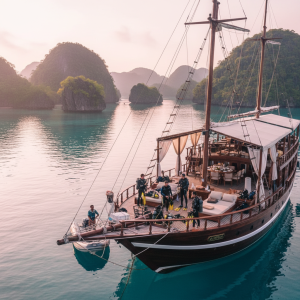
The first light of dawn spills across the Banda Sea, catching the twin masts of the phinisi in a warm, amber glow. Below my bare feet, the hand-hewn ironwood deck is cool and solid, a testament to centuries of Bugis shipbuilding tradition. A gentle, rhythmic creak is the only sound, accompanied by the whisper of water parting at the bow. We are gliding through the waters of Raja Ampat, and here, more than anywhere else on earth, the journey—the specific, deliberate path charted through these 1,500 islands—is the destination. The choice of route dictates not just what you see, but the very pulse and character of your expedition into this last true marine frontier.
The Classic Dampier Strait & Wayag Expedition: An Icon’s Itinerary
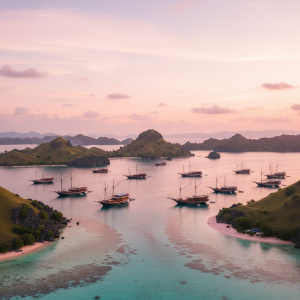
For those making their inaugural voyage into the Four Kings, the central and northern passage is non-negotiable. This is the Raja Ampat of postcards and documentaries, a route that delivers a powerful concentration of the region’s most celebrated wonders. Our journey typically begins from the bustling port of Sorong, and within hours, the phinisi enters the Dampier Strait. This channel, separating the islands of Waigeo and Batanta, acts as a superhighway for marine life. As our expedition leader, Adi, a man with two decades of experience navigating these waters, explained, “The Indonesian Throughflow funnels immense volumes of water from the Pacific to the Indian Ocean right through this strait. The resulting currents, which can exceed six knots, are the engine of this ecosystem.” This constant nutrient flow supports a staggering density of life, with scientists having recorded 1,711 species of fish here. Our first major stop is often Manta Sandy, a world-renowned cleaning station where oceanic manta rays, with wingspans reaching up to seven meters, congregate to have parasites removed by smaller reef fish. It’s a mesmerizing, silent ballet. From there, the route winds north to Pianemo, where a 320-step climb reveals a panoramic vista of star-shaped, turquoise lagoons dotted with verdant karst islets. The ultimate prize, however, lies further north: the otherworldly seascape of Wayag. After anchoring in a protected bay, a steep, rugged climb up Mount Pindito rewards you with the definitive view of Raja Ampat—a breathtaking mosaic of mushroom-shaped islands set in a sea of impossible blue. This route, typically spanning 8 to 10 days, is a masterclass in ecological grandeur.
The Southern Labyrinth: A Misool Deep Dive for the Connoisseur
If the northern route is a symphony of grand, sweeping vistas, the southern passage through the Misool archipelago is an intimate chamber piece, composed of intricate details and profound solitude. This is the preferred route for seasoned Raja Ampat visitors and dedicated divers seeking a more immersive, off-the-grid experience. Misool’s geography is fundamentally different; it’s a sprawling, 2,000-square-kilometer maze of limestone islands, eroded by time into a labyrinth of hidden lagoons, secret channels, and submerged caves. The conservation success story here is palpable. The establishment of the 1,220-square-kilometer Misool Marine Reserve, a no-take zone fiercely protected by a local ranger patrol, has yielded astonishing results. Scientific surveys have shown a 250% average increase in fish biomass inside the protected area in just six years. On a recent charter aboard the Dewi Nusantara, we spent three days exploring the area around Daram, Boo, and Fiabacet, diving through coral gardens so vibrant they seemed almost artificial. The sheer density of soft corals in sites like “Magic Mountain” is unparalleled. Beyond the diving, Misool offers unique experiences. We kayaked into a hidden lagoon to swim among thousands of harmless, pulsating golden jellyfish in Lenmakana Lake. Another afternoon was spent visiting the ancient petroglyphs, ochre-hued handprints and symbols painted on limestone cliffs between 3,000 and 5,000 years ago, a direct link to the region’s earliest inhabitants. As a destination, Misool demands more time—a minimum of 10 days—and a greater tolerance for longer open-water crossings, but the reward is a sense of discovery that has all but vanished from the modern world. It is so significant that it is part of the area’s Tentative List for UNESCO World Heritage status.
The Equator Crossing: A Kawe & Aljui Bay Combination
For the traveler who has “been there, done that,” a specialized itinerary focusing on the far northern islands offers a unique narrative: crossing the equator on a traditional wooden schooner. This route combines the raw, wild beauty of Wayag with the more esoteric charms of Kawe and Aljui Bay. Departing from the Dampier Strait, the phinisi charts a course northwest towards Waigeo’s vast Aljui Bay. This deep, fjord-like bay is home to one of Indonesia’s most prestigious South Sea pearl farms. A private tour of the Atlas Pearl Farm provides a fascinating glimpse into the meticulous, multi-year process of cultivating Pinctada maxima oysters, which can produce lustrous pearls up to 20mm in diameter. The diving here is different, focusing on muck and macro life—mandarinfish, ghost pipefish, and a menagerie of rare crustaceans. From Aljui, the voyage continues north to the island of Kawe. It is here, among a cluster of uninhabited islands, that the ship’s GPS will ceremoniously tick over from a southern to a northern latitude. The crew often marks the occasion with a small ritual. Kawe is also a geological marvel, straddling two tectonic plates, and its dive sites, like “Eagle Rock,” are known for powerful currents that attract large schools of fusiliers, barracuda, and reef sharks. This itinerary appeals to a specific type of explorer—one fascinated by geography, aquaculture, and the simple, profound romance of crossing a significant line on the globe. It is a testament to the versatility of an indonesia luxury phinisi, which can transform from a dive platform into a vessel of pure exploration.
Crafting a Bespoke Voyage: The Art of the Private Charter
While defined routes provide a useful framework, the pinnacle of exploring Raja Ampat lies in the boundless freedom of a private charter. The true value of securing your own vessel is not merely privacy, but the ability to craft a fluid, highly personalized itinerary in collaboration with an expert crew. The best bespoke charters across Komodo, Raja Ampat & the Banda Sea begin not with a map, but with a conversation. Are you an avid birdwatcher, hoping to trek inland at dawn to witness the elaborate mating dance of the Red Bird-of-Paradise? The captain can adjust the schedule to anchor near a known lek on Waigeo. Are you a professional underwater photographer focused on pygmy seahorses? The cruise director will design a route that prioritizes the specific dive sites where Bargibanti and Denise pygmy seahorses are found. A family with young children might prefer a route with more calm, sandy beaches and easy snorkeling spots, like those around the Fam Islands. A typical 10-night charter might involve over 200 nautical miles of travel, and the logistics of provisioning, fuel, and securing permits for this remote region are immense. This is where the deep, local knowledge of the vessel’s operator becomes critical. They understand the subtle shifts in wind and current, the seasonal aggregation of certain species, and how to be at the right place at the right time, far from any other boats. This level of customization transforms a trip into a life-altering expedition, entirely tailored to your own rhythm of discovery.
The Logistical Canvas: Understanding Seasons, Access, and Conditions
A successful expedition hinges on understanding the practicalities of the region. The primary factor governing all raja ampat luxury phinisi sailing routes is the weather, dictated by two distinct monsoons. The prime sailing season runs from roughly October through April, during the northwest monsoon. This period generally brings calmer seas, sunnier skies, and excellent water visibility, often exceeding 30 meters. This is the ideal time for the classic Wayag route and for comfortable open-sea crossings. From May to September, the southeast monsoon prevails, bringing stronger winds and more frequent rain, particularly affecting the southern archipelago. While sailing is still possible, surface conditions can be choppy, and some operators relocate their fleets to other parts of Indonesia, like Komodo. The water temperature remains a consistent 28-30°C (82-86°F) year-round. Access to this remote paradise is almost exclusively through the Domine Eduard Osok Airport in Sorong (SOQ). There are no direct international flights; travelers must connect through major Indonesian hubs like Jakarta (CGK), Makassar (UPG), or Manado (MDC). From the airport, it’s a short transfer to the port where your phinisi awaits. As advised by the official indonesia.travel portal, all visitors must also purchase a Marine Park entry permit, the fee for which directly supports conservation and local community initiatives. A well-planned trip accounts for these logistics, ensuring the journey to the boat is as seamless as the voyage itself.
Quick FAQ on Raja Ampat Phinisi Routes
What is the ideal trip duration for a Raja Ampat charter? While a 7-night trip is possible, it feels rushed. To truly appreciate either the northern or southern region without spending too much time in transit, a 10 to 12-night charter is ideal. This allows for multiple dives or excursions at key sites and provides flexibility to linger if you discover something extraordinary.
How much does a private phinisi charter in Raja Ampat cost? The price varies significantly based on the vessel’s size, age, and level of luxury. A high-quality, comfortable phinisi for a small group might start around $5,000 to $7,000 USD per night. The most opulent, newly built yachts with extensive amenities and large crews can command upwards of $15,000 to $20,000 USD per night, typically on an all-inclusive basis (excluding alcohol and park fees).
Should I choose the North (Wayag) or the South (Misool) for my first trip? This depends entirely on your priorities. For the iconic, dramatic landscapes you’ve seen in photographs, the North is a must. It delivers the “wow” factor. For a more adventurous, remote, and dive-centric experience with world-class soft coral reefs and a greater sense of solitude, Misool in the South is unparalleled. Many repeat visitors choose to focus exclusively on Misool.
What level of diving certification is required? An Open Water certification is sufficient to enjoy many of the beautiful, shallow reefs. However, to experience the full spectrum of Raja Ampat’s underwater world—including the deeper pinnacles and sites with stronger currents where large pelagic species congregate—an Advanced Open Water certification is highly recommended. Many of the most rewarding sites are best experienced with the confidence and skill set that comes with advanced training.
The sheer number of islands in Raja Ampat means that even after a dozen voyages, you would only have scratched the surface. Each bay holds a secret, each reef a new discovery. The route you choose is the narrative thread that weaves these moments together, creating a story that is uniquely yours. It is an investment not in a vacation, but in a perspective-altering encounter with one of the last truly wild places on our planet. To begin designing your own journey through the world’s most vital marine ecosystem, explore the curated fleet of vessels at our Indonesia Luxury Phinisi atelier. Our specialists work directly with the most experienced captains and crews to translate your aspirations into a tangible, unforgettable voyage.